

Chapter 1: Africa Continental Free Trade Agreement (AfCFTA) – Structure, Objectives and Context
This chapter provides an exposition of the AfCFTA, its key elements and its objectives. First,
the structure of the AfCFTA agreement is presented. Thereafter, the chapter provides the
precolonial intra-Africa trade routes and context that spans over two thousand years. Light is
cast on geopolitical events that shaped the establishment of intra-Africa trade treaties, the
African Union and eventually the AfCFTA. The prevailing theme that shows up in the African
Union (AU) texts, the Abuja Treaty, and AfCFTA texts, is the exigency to unite Africa, to
integrate Africa and boost intra-Africa trade. I should point out upfront that the vast historical
context of intra-Africa trade cannot be captured in one chapter, let alone in one manuscript.
Thus, reference to the precolonial and colonial intra-Africa trade routes cited in the chapter does
not diminish the criticality of a multitude of intra-Africa trade routes not cited that shaped the
establishment of the AfCFTA. The contextual details provided in this chapter are only an
attempt to expand the contexts that shaped the establishment of the AfCFTA beyond the
formation of the OAU in 1963, beyond the signing off of the Abuja treaty in 1991, and beyond
the establishment of the colonial and post-colonial regional economic communities.
Appreciating the contexts of intra-Africa trade provides a backdrop to understand what is at
stake in achieving the African Union’s aspirations of a prosperous, integrated, united and
peaceful Africa. To address historical bias, I have attempted to provide evidence from a variety
of sources, and I have also provided different alternative views on the cultural and historical
context of the AfCFTA. For instance, in the last part of the chapter, I highlight some of the
important critiques of AfCFTA, especially what scholars have presented as a neocolonial
approach to integrating Africa.
The AfCFTA Objectives and its Key Elements
The AfCFTA is a flagship project of the African Union Agenda 2063, with a mandate to create
a single continental market that brings together 1.3 billion people, a combined GDP of
approximately US$ 3.4 trillion, 54 countries, and eight regional economic communities
(African Union, 2018). The AfCFTA is expected to expand the size of Africa’s economy to
US$29 trillion by 2050 (Afreximbank, 2023). The Agreement further seeks to liberalise trade
among participating countries in order to deepen economic integration and to enhance
competitiveness through economies of scale, while promoting industrialisation and sustainable
and inclusive socio-economic development. The AfCFTA is also a binding legal instrument
that legitimises the creation of a single continental market for goods and services as well as
people and investments (African Union, 2022). All African Union (AU) countries, except
Eritrea, had become signatories to the Africa Continental Free Trade Agreement (AfCFTA),
which came into force on 30 May 2019. With 54 out of the 55 AU member States having signed
the AfCFTA agreement, the trade policy is the largest Free Trade Agreement in the world in
terms of participating countries since the formation of the World Trade Organization in 1994
(Afreximbank, 2023).
The fundamental objective of the AfCFTA is to boost intra-Africa trade, which is currently
sitting at 16.6 percent of the total African trade (AfCFTA, 2022). Intra-Africa trade is envisaged
to be achieved by operationalising trade instruments, Protocols and Annexes that constitute the
Agreement. Figure 1 presents the AfCFTA Framework consisting of eight Protocols: (1)
Protocol on Trade in Goods with nine Annexes: (2) Protocol on Trade in Services with five
Annexes; (3) Protocol on Rules and Procedures for the Settlement of Disputes with three
Annexes; (4) Protocol on Competition Policy; (5) Protocol on Investment; (6) Protocol on
Intellectual Property Rights; (7) Protocol on Youth and Gender in Trade; (8) Protocol on Digital
Trade.
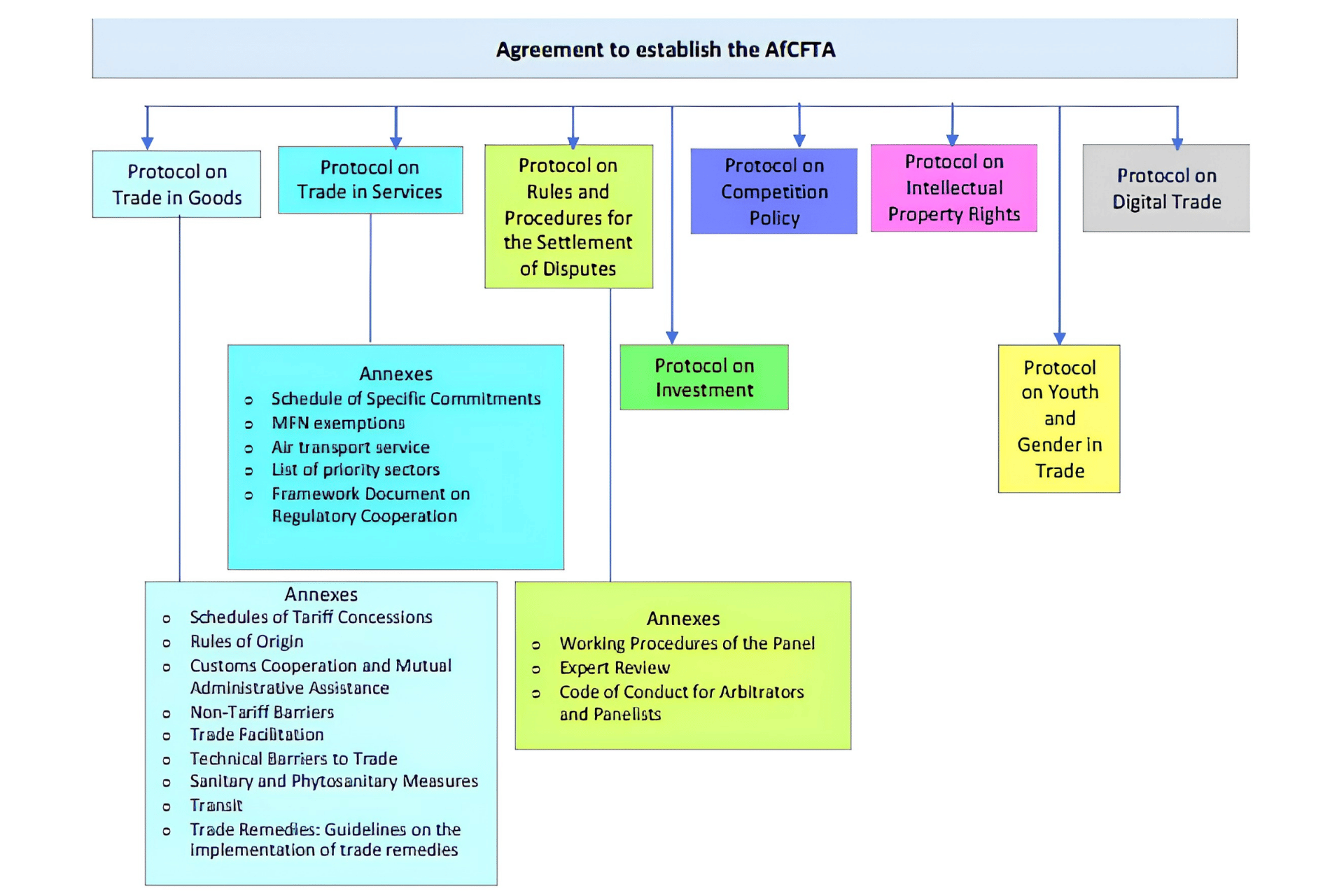
Source: Adapted from Republic of South Africa: Department of Trade, Industry and Competition 2024
The Protocols and Annexes make provision for the operationalisation of the seven AfCFTA
objectives: (1) to eliminate tariffs and non-tariff barriers to trade in goods progressively; (2)
Agreement to establish the AfCFTA
Protocol on
Trade in Goods
Protocol on
Trade in Services
Protocol on
Investment
Protocol on
Rules and
Procedures for
the Settlement
of Disputes
Protocol
on Youth
and
Gender in
Trade
Protocol on
Intellectual
Property Rights
Protocol on
Competition
Policy
Annexes
o Schedule of Specific Commitments
o MFN exemptions
o Air transport service
o List of priority sectors
o Framework Document on
Regulatory Cooperation
Annexes
o Working Procedures of the Panel
o Expert Review
o Code of Conduct for Arbitrators
and Panelists
Annexes
o Schedules of Tariff Concessions
o Rules of Origin
o Customs Cooperation and Mutual
Administrative Assistance
o Non-Tariff Barriers
o Trade Facilitation
o Technical Barriers to Trade
o Sanitary and Phytosanitary Measures
o Transit
o Trade Remedies: Guidelines on the
implementation of trade remedies
Protocol on
Digital Trade
liberalise trade in services progressively; (3) cooperate on investment, intellectual property
rights and competition policy; (4) cooperate on all trade-related areas; (5) cooperate on customs
matters and implementation of trade facilitation measures; (6) establish a mechanism for the
settlement of disputes concerning members’ rights and obligations; (7) establish and maintain
an institutional framework for the implementation and administration of the AfCFTA. The link
between the AfCFTA to the African Union’s Agenda 2063 finds expression in Article of the
Agreement Establishing the African Continental Free Trade Area, which points to the
deepening of the economic integration of the African Continent (African Union, 2022). Indeed,
the African Union’s 2063 Agenda Framework puts forward Eight Priorities of the 2063 Agenda
in a document titled “The Africa We Want” as outlined in Box 1.
There are two groups of countries under the AfCFTA trade regime – the Least Developed
Countries (LDCs) and non-LDCs. The LDCs are given a longer period to liberalise trade due
to the development challenges they face. They are allowed 10 years to liberalise 90% of their
tariff lines in the first phase, and 13 years for their sensitive products, which constitute 7% of
their tariff lines. Non-LDCs, on the other hand, have five years to liberalise 90% of their tariff
lines and 10 years to liberalise their sensitive tariff lines.
Source: African Union (2024). 2063 AU Agenda Framework Document – The Africa We Want
The Historical Context that Shaped the Establishment of the AfCFTA
Trade, throughout history, has been the means through which human interaction and the
exchange of ideas and commodities have been made possible. In a study commissioned by
Afreximbank (2017), Akyeampong traces trade to historical events that span over 10,000 years.
This section focuses on intra-Africa trade routes that can be traced back to about 2000 years
before colonisation, and trade routes during the process of decolonising Africa. To start off, let
us define the concepts of colonisation and decolonisation. Without trying to simplify a concept
covered in volumes of literature (see for example, Fanon, 1963; Golding 1994; Fanon, 1967;
Mufwene 2002;) I submit a definition of colonisation provided by Hook (2004, p. 88 cited in
Said’s 1978) work that views colonisation as a violent practice that dispossesses people of their
native territory. “We get deeper insights into the meaning of colonialization when viewing it
from the coloniser’s point of view aptly expressed by Albert Sarraut, the Colonial Minister for
France (cited in Afreximbank 2023, p16).
Economically a colonial possession means to the home country simply a privileged market
whence it will draw the raw materials it needs, dumping its own manufactures in return.
Economic policy is reduced to rudimentary procedures of gathering crops and bartering them.
Moreover, by strictly imposing on its colonial “dependency” the exclusive consumption of its
manufactured products, the metropolis prevents any efforts to use or manufacture local raw
material on the spot, and any contact with the rest of the world. The colony is forbidden to
establish any industry, to improve itself by economic progress, to rise above the stage of
producing raw materialism or to do business with the neighbouring territories for its own
enrichment across the customs barriers erected by the metropolitan power.
Decolonisation, on the other hand, is the period coinciding with the end of the Second World
War, characterised by agitations for independence and colonial powers eventually granting
independence to former colonies. Snippets of the precolonial and colonial historical context of
the trade routes provided below show that intra-Africa trade has been happening for thousands
of years, with different transport and currency exchange modalities. To understand this rich
history let us look at the trade routes that existed before colonialism and during colonial rule.